Blast Freezer for Ice Cream: TunelGroup’s Solutions for Controlled Product Hardening
Blast Freezer for Ice Cream systems harden partially frozen ice cream after filling, forming or extrusion. TunelGroup develops project-specific hardening rooms that combine low-temperature refrigeration, insulated construction, engineered airflow, product monitoring and controlled transfer to frozen storage.
Hardening is a defined stage in the ice cream process. The initial freezer develops the partially frozen and aerated product; the hardening system removes additional heat after the product is shaped or packed. Formulation, overrun, container dimensions, fill weight and the required storage condition must be considered together.
Why Is Blast Hardening Important for Ice Cream?
Freshly filled ice cream still contains a significant unfrozen phase. A controlled hardening process reduces product temperature and freezes more of the remaining water before the packages enter frozen storage or distribution.
A blast freezer for ice cream coordinates four practical requirements:
- Defined process stage: distinguish initial freezing and whipping from post-fill hardening.
- Recipe-specific performance: account for sweeteners, total solids, inclusions, overrun and product density.
- Uniform heat removal: provide airflow through the actual rack, trolley or conveyor arrangement.
- Product-based release: verify the condition of the slowest-cooling container before transfer.
A low air-temperature display does not prove that every package has reached the required condition. The product endpoint, maximum time, package format and loading pattern should be stated together in the process specification.
TunelGroup’s Tailored Blast Freezer Solutions for Ice Cream
Small retail cups, deep catering tubs, filled cones and extruded products present different heat-transfer duties. The planned product and its production route should be defined before the hardening capacity is selected.
| Application or Requirement | Project-Specific Solution |
|---|---|
| Filled Cups and Small Tubs | Evaluate fill weight, container depth, lid closure and rack spacing at the actual production rate. |
| Deep Catering Containers | Identify the slowest-cooling centre and assess the effect of package depth, outer cartons and bundling. |
| Extruded Products | Coordinate tray movement, product spacing, air direction and the transfer route through a hardening tunnel. |
| Cones, Sandwiches and Coated Items | Include wafers, coatings, toppings, decorations and package protection in the product trial. |
| Hardening Air Temperature | University of Guelph guidance describes approximately −30°C to −40°C for blast hardening. Final selection depends on the product, package and equipment. |
| Product Endpoint | Define a validated product temperature or firmness criterion at the slowest-cooling location before transfer to storage. |
| Frozen Storage Condition | Specify storage separately from the hardening air setting, with permitted temperature fluctuation and distribution conditions documented. |
| Product Mass and Overrun | Use measured net fill weight or verified density. Litres of aerated ice cream cannot be treated as an equivalent mass of water. |
| Capacity and Cycle Time | State net kilograms or package count per batch or hour, including transfer, loading, defrost, cleaning and room recovery. |
Technical references: University of Guelph — Hardening and Tetra Pak Dairy Processing Handbook — Ice Cream. The published air ranges describe processing references; they do not guarantee a universal cycle for every recipe or package.
Key Features of TunelGroup’s Ice Cream Blast Freezers
- Custom hardening layout: trolley dimensions, conveyor routes, loading lanes and door positions coordinated with the filling line.
- Low-temperature insulated construction: walls, ceiling, floor and door details selected for the operating duty and external conditions.
- Application-specific refrigeration: equipment evaluated for the incoming partially frozen product, packages and room loads.
- Engineered air distribution: evaporators, supply passages and baffles arranged around the actual load.
- Monitoring and control: product probes, room sensors, cycle records and alarms included according to the agreed scope.
- Hygienic construction: cleanable surfaces, service access and protected condensate drainage considered during design.
How TunelGroup Improves Ice Cream Hardening Consistency
Consistent hardening depends on the relationship between the formulation, filling line and freezer. Project development should establish:
- Recipe information: sweetener system, total solids, inclusions, overrun, density and intended serving or storage condition.
- Transfer control: maximum time from the filler or forming station to the hardening room and the actual product entry temperature.
- Loading discipline: container spacing, rack positions, permitted bundling and clear supply-and-return air paths.
- Product acceptance: temperature, firmness, package condition, shape and surface quality checked after the defined cycle.
University of Guelph identifies air temperature, air circulation, product entry temperature, container size, composition and stacking as factors that influence hardening. These variables should be included in loaded trials rather than inferred from an empty-room test.
Changes to recipe, fill weight, container depth, toppings or outer packaging may alter the approved cycle. Reassess the process when a product format changes.
Visual Highlights: TunelGroup’s Ice Cream Blast Freezer
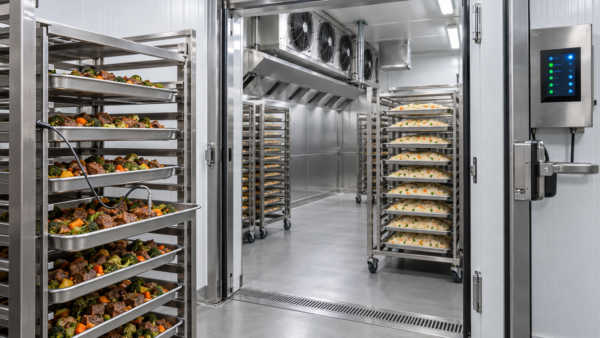
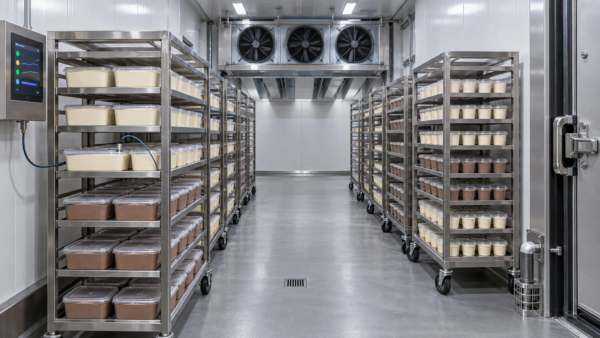
The illustration presents a hygienic hardening room with stainless-steel racks, filled ice cream packages and product temperature monitoring.
Dedicated Package Arrangements
Vanilla and chocolate tubs and cups are shown on separate rack areas. Each container format requires its own fill weight, spacing, loading limit and hardening specification.
Refrigeration and Insulated Envelope
Low-temperature evaporators, air passages and a heavy-duty door are coordinated with the room envelope. Equipment capacity, defrost arrangements and insulation thickness follow the project calculation.
Product Temperature Monitoring
A probe in a designated sample tub provides product-level information alongside the room sensors. The monitoring package and probe location should represent the slowest-cooling commercial format.
Illustrative image. Final equipment, package types, rack positions and room dimensions depend on the approved project.
Benefits of Choosing TunelGroup for Ice Cream Hardening
- Product-focused configuration: equipment evaluated around your recipes, packages and production route.
- Clear capacity targets: defined net product mass and package counts provide a basis for scheduling.
- Repeatable operation: documented loading patterns help operators follow the approved method.
- Energy planning: insulation, door use, fan duty and defrost reviewed together.
- Batch visibility: monitoring options can associate temperature records with production lots.
- Line integration: room planning connects filling, hardening, frozen storage and dispatch.
Why Choose TunelGroup for Your Ice Cream Hardening Project?
TunelGroup brings insulated construction, refrigeration and controls into one engineering discussion. The aim is to align the proposal with your filling line, product formats, available space and required output.
- Application review: product formulation, overrun, fill weight, container depth and entry condition assessed before selection.
- Coordinated components: panels, doors, evaporators and refrigeration considered as one system.
- Project-based layout: transfer routes, service clearances and rack or conveyor positions developed around the intended operation.
- Defined supply scope: equipment, transport, installation and commissioning responsibilities clarified in the quotation.
- Technical documentation: project information and operating guidance provided according to the agreed scope.
- Maintenance planning: coil access, defrost and hygienic cleaning considered alongside production schedules.
Additional Benefits of TunelGroup Blast Freezers
- Format flexibility: cups, tubs, cones and extruded products can be assessed with separate operating specifications.
- Remote visibility: data logging and alarm functions can be included when specified.
- Cold-chain coordination: completed loads can be transferred into frozen storage according to a defined temperature-control plan.
Conclusion
A blast freezer for ice cream should be specified around the formulation, overrun, fill weight, package dimensions, product entry condition and production schedule. Product temperature records and finished-product checks provide a practical basis for commissioning and daily operation.
Hardening does not replace hygienic production or controlled frozen storage. Temperature fluctuations can affect ice-crystal stability and product texture. Explore our ice cream blast hardening guide for more information about temperature stability and product hardening.
Price
The price of a blast freezer for ice cream depends on room dimensions, product format, net batch mass, package depth, entry condition, hardening cycle, insulation, refrigeration, controls and installation scope.
For a project-specific quotation, provide the location, product types, formulation and overrun, package dimensions, fill weight, production rate, transfer conditions, frozen-storage requirements and electrical supply. Contact TunelGroup to discuss the required configuration.