


−45°C Blast Freezer: 15 Essential Engineering Checks
Cold Storage Pioneer in Industrial Design
−45°C Blast Freezer: 15 Essential Engineering Checks
Author: Hamza Ilıman
Last updated: November 18, 2026
Blast Freezer systems operating at −45°C air temperature use forced circulation to remove sensible and latent heat from food. A complete Blast Freezer specification must define the product, tonnes per batch, entry temperature, package thickness, required core temperature and available cycle time. Room temperature alone cannot establish how many tonnes can be frozen or how long the process will take.
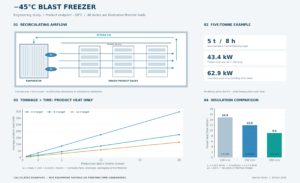
For example, freezing 5 tonnes in 8 hours with an assumed product enthalpy change of 250 kJ/kg creates an average product load of 43.4 kW. Blast Freezer capacity must also cover the room envelope, fans, packaging, infiltration and other operating loads. The eight-hour target still requires product freezing-time verification.
This guide explains the engineering behind a −45°C Blast Freezer, including measured freezing-time references, capacity calculations, panel comparisons and a complete worked example.
Calculation basis: The calculated duties, room dimensions, fan settings and schedules below are illustrative engineering assumptions. They are not measured TunelGroup project results or guaranteed equipment ratings. All tonnes are metric tonnes: 1 t = 1,000 kg.
Contents
- Separate air, refrigerant and product temperatures
- Understand the freezing load
- Establish realistic freezing hours
- Convert batch tonnage into daily throughput
- Calculate product refrigeration duty
- Examine a five-tonne design example
- Engineer airflow through the load
- Select the blast evaporator
- Match the compressor and refrigeration circuit
- Specify panels and joints
- Engineer the floor
- Detail doors and pressure equalisation
- Plan defrost and drainage
- Control and verify the process
- Commission, maintain and measure performance
1. What Does −45°C Mean in a Blast Freezer?
Three temperatures describe different parts of the process.
| Parameter | Illustrative design value | Meaning |
|---|---|---|
| Controlled process air | −45°C | Air at the agreed reference sensor during the established freezing period |
| Refrigerant evaporation | −53°C | Example selection point with an 8 K difference from reference air |
| Product entry temperature | +5°C | Temperature before this example batch enters |
| Product core endpoint | −18°C or colder, as specified | Acceptance condition checked in the slowest-cooling product |
| Outdoor design temperature | +35°C | Example condenser intake environment |
| Refrigerant condensation | +45°C | Example selection point; distinct from outdoor temperature |
An evaporator selected at −53°C is not proof that the entire room stays at −45°C under load. Supply air, return air and air between packages differ during the cycle.
The Codex code for quick frozen foods identifies completion at −18°C or colder at the thermal centre after temperature stabilisation. Its scope excludes ice cream, edible ices and milk; those require separate product criteria. fao.org
A purchaser requiring −45°C at the product centre is asking for a substantially different process. That requirement needs a colder medium and its own time, equipment and energy assessment.
2. Understanding the Blast Freezer Product Load
A Blast Freezer removes heat in three overlapping stages:
- Cooling before freezing: bringing the product from its entry temperature towards its initial freezing point.
- Ice formation: removing latent heat as water progressively freezes.
- Cooling the frozen product: reducing its temperature to the required endpoint.
Food freezes over a temperature range. Water, fat, salt and sugar content affect the relationship between temperature and enthalpy.
For design calculations, use the product’s enthalpy difference between the specified inlet and outlet conditions. A simple mass × specific heat × temperature difference calculation omits latent heat unless the method explicitly accounts for it.
The same five-tonne load can therefore require different refrigeration duties when it contains lean fish, fatty meat, bread dough or prepared meals.
Hot cooked food also requires a validated cooling process. Freezing does not make inadequate handling acceptable and should not be treated as a general microbial kill step. fao.org
3. Blast Freezer Freezing Times: What Can Be Supported?
Published measurements provide a useful reference
The following values come from FAO’s freezing-time table. These examples start at +5°C and finish at −20°C at the fish centre.
| Product configuration | Air temperature | Air velocity | Observed freezing time |
|---|---|---|---|
| Scampi meat, 18 mm thick | −35°C | 3 m/s | 26 minutes |
| Haddock fillets, 50 mm thick, metal tray | −35°C | 4 m/s | 2 h 05 min |
| Packaged fillets, 50 mm thick | −35°C | 2.5–5 m/s | 5 h 15 min |
| Individual whole fish, approximately 125 mm thick | −35°C | 5 m/s | 5 hours |
These are historical measurements at −35°C, not −45°C performance promises. FAO also notes that commercial operation needs allowances for discrepancies. 5. Freezing time
For larger meat formats, the FAO meat storage manual gives approximately 16–20 hours for beef half-carcasses or quarters under its described blast-freezing conditions of roughly −30°C to −35°C, sometimes −40°C. This should not be transferred directly to densely packed cartons or another core endpoint. fao.org
Why a lower air setpoint does not produce one universal cycle time
A −45°C Blast Freezer increases the temperature difference driving heat transfer. Nevertheless, the centre of a thick package remains limited by heat conduction through the product, packaging resistance and local airflow.
Two loads with equal mass can freeze at very different rates:
- Thin portions spread across trays have short heat-transfer paths.
- Thick cartons have a longer path to the centre.
- Closely packed pallets can obstruct the air passages.
- Trapped air inside packaging adds thermal resistance.
A first estimate may use a validated freezing model. The final Blast Freezer recipe should be established by temperature measurements in representative slow-cooling locations. fao.org
4. Blast Freezer Capacity: Tonnes per Batch and Tonnes per Day
Batch capacity describes the product mass processed in one loading. Daily throughput also depends on handling, defrost, cleaning and recovery.
Cycle time = freezing time + loading/unloading + defrost and recovery + allocated cleaning time
The table below assumes 20 available production hours per day and an illustrative two-hour turnaround per batch.
| Validated freezing period | Total cycle | Completed cycles within 20 h | 1 t/batch | 5 t/batch | 10 t/batch |
|---|---|---|---|---|---|
| 4 h | 6 h | 3 | 3 t/day | 15 t/day | 30 t/day |
| 8 h | 10 h | 2 | 2 t/day | 10 t/day | 20 t/day |
| 12 h | 14 h | 1 | 1 t/day | 5 t/day | 10 t/day |
| 18 h | 20 h | 1 | 1 t/day | 5 t/day | 10 t/day |
This is a schedule calculation, not a list of available machine ratings. The 20-hour window begins and ends without a partly completed batch; multi-day rolling operation can give a different average.
Likewise, tonnes of product and tons of refrigeration are different units. One refrigeration ton is approximately 3.517 kW of cooling capacity.
5. Blast Freezer Refrigeration Load by Tonnage and Hours
For a batch Blast Freezer:
Average product load, kW = mass, kg × enthalpy change, kJ/kg ÷ (3,600 × active freezing hours)
The following matrix uses Δh = 250 kJ/kg solely as an example.
| Product per batch | 4 h target | 8 h target | 12 h target | 24 h target |
|---|---|---|---|---|
| 0.5 t | 8.7 kW | 4.3 kW | 2.9 kW | 1.4 kW |
| 1 t | 17.4 kW | 8.7 kW | 5.8 kW | 2.9 kW |
| 2 t | 34.7 kW | 17.4 kW | 11.6 kW | 5.8 kW |
| 5 t | 86.8 kW | 43.4 kW | 28.9 kW | 14.5 kW |
| 10 t | 173.6 kW | 86.8 kW | 57.9 kW | 28.9 kW |
| 20 t | 347.2 kW | 173.6 kW | 115.7 kW | 57.9 kW |
These figures cover product heat only. They neither select a complete refrigeration unit nor establish that a particular product can physically freeze within the stated period.
For another enthalpy difference, scale the figures by:
Actual Δh ÷ 250
If Δh is 300 kJ/kg, every entry increases by 20%.
At 250 kJ/kg, each tonne contains approximately 69.4 kWh of removable product heat. That is thermal energy, not electricity consumption.
A batch load also varies over time. Equipment matching must consider the peak load, control response and the product cooling curve, rather than relying exclusively on an average.
6. Worked Example: A Five-Tonne Blast Freezer
Consider the following preliminary study:
| Design input | Assumption |
|---|---|
| Product | Packaged boneless meat |
| Batch mass | 5,000 kg |
| Entry / target core | +5°C / −18°C |
| Active freezing target | 8 hours |
| Process air / evaporation | −45°C / −53°C |
| Outdoor air / condensation | +35°C / +45°C |
| Product enthalpy change | 250 kJ/kg, assumed |
| Internal calculation envelope | 8 × 6 × 4 m |
| Insulation used in calculation | 200 mm; assumed planar U = 0.113 W/m²K |
| Temperature below floor insulation | +15°C, assumed |
The Blast Freezer envelope is used for heat-transfer arithmetic. The ability to fit five tonnes with adequate passages must be established separately from carton and handling drawings.
Wall area is 112 m², ceiling area 48 m², and floor area 48 m².
Ignoring joints and thermal bridges for the first step:
Transmission = 0.113 × [(160 × 80) + (48 × 60)] ≈ 1.77 kW
A preliminary load budget could then be:
| Load component | Example average duty |
|---|---|
| Product freezing | 43.4 kW |
| Packaging and handling equipment | 1.5 kW |
| Planar walls, ceiling and floor | 1.8 kW |
| Additional joints and thermal bridges | 0.5 kW |
| Infiltration averaged over the duty | 3.0 kW |
| Fans and motors inside the refrigerated space | 6.0 kW |
| Lighting and internal heater contribution | 1.0 kW |
| Subtotal | 57.2 kW |
| Illustrative 10% engineering allowance | 5.7 kW |
| Preliminary gross refrigeration duty | 62.9 kW |
Except for the product and planar transmission calculations, these entries are assumed allowances requiring project calculations. The 10% margin is not a universal sizing rule.
The resulting Blast Freezer study point is approximately 63 kW of refrigeration at the specified low-temperature duty, including the assumed fan heat. It is not 63 kW of electrical input.
This example assumes no defrost interruption during the eight-hour freezing period. Between-batch defrost, room recovery and handling must fit the separate turnaround window. Their energy and recovery capacity must be checked.
Specify whether evaporator data are gross or net of fan heat to avoid counting that load twice.
7. Engineer Blast Freezer Airflow Through the Product
A Blast Freezer requires air to pass through the load. High airflow around the outside of a tightly wrapped pallet does little for its centre.
Use a supply plenum, product passages, bypass barriers and a defined return route. Loading patterns should be repeatable.
An initial study may investigate approximately 2–5 m/s at exposed product passages, followed by product-specific testing. This is a starting range, not a universal requirement. FAO’s meat guidance describes 2–4 m/s and higher velocities in some applications. fao.org
Example airflow and fan calculation
Assume:
- Combined free passage area: 6 m²
- Average velocity through that area: 4 m/s
- Total pressure requirement at the duty: 150 Pa
- Overall fan/motor efficiency: 60%
Then:
Airflow = 6 × 4 = 24 m³/s = 86,400 m³/h
Fan electrical power ≈ 24 × 150 ÷ 0.60 = 6,000 W
These assumptions are consistent with the illustrative 6 kW fan heat in the previous example. They do not specify a fan model.
At an assumed air density of 1.55 kg/m³ and specific heat of 1.0 kJ/kgK, carrying 63 kW with this airflow gives an approximate sensible air-temperature rise of 1.7 K.
Actual fan selection must include coil, product, duct, baffle and frost resistance at the operating air density. Nominal free-air volume is insufficient.
8. Select the Blast Freezer Evaporator at Its Actual Duty
The Blast Freezer selection sheet should state:
| Selection item | Required confirmation |
|---|---|
| Refrigerant and feed arrangement | Compatibility with the complete circuit |
| Reference air and evaporation temperatures | Defined temperature difference and rating convention |
| Gross/net capacity | Treatment of fan heat clearly stated |
| Fan performance | Volume at required external resistance and actual air density |
| Fin geometry | Frost capacity, cleanability and pressure loss |
| Defrost | Method, installed duty and control sequence |
| Construction | Low-temperature suitability of metals, seals, cables and motors |
| Drainage | Heated/protected tray and drain arrangement where required |
Dedicated blast air coolers use forced airflow and purpose-designed coil arrangements. Their published nominal capacity still needs correction to the actual application. Güntner
TunelGroup’s shock-type evaporators provide a starting point for product selection. A −45°C proposal requires a model-specific selection confirming the lower duty, fan performance and defrost arrangement.
Do not specify fin spacing from air temperature alone. For example, comparing 8, 10 and 12 mm options can form part of a frost-loading study; none is automatically correct for every −45°C room.
9. Match the Blast Freezer Compressor and Refrigeration Circuit
At −45°C room air, the refrigerant must usually evaporate at a lower temperature. The compressor must operate within its approved envelope across pull-down, normal operation and recovery.
Evaluate:
- Capacity at the actual evaporating and condensing conditions.
- Refrigerant-specific limits and temperature glide conventions.
- Suction superheat, liquid subcooling and suction-line losses.
- Discharge temperature, motor current and oil management.
- Low-load control and oil return.
- Heat rejection under the maximum outdoor design condition.
Two-stage compression, an economised arrangement or a suitable cascade system may be considered. The correct architecture depends on duty, refrigerant, climate and service capability; −45°C air does not automatically mandate one arrangement.
BITZER’s two-stage compressor documentation illustrates equipment developed for very low-temperature applications. Final selection still requires the manufacturer’s software and operating limits. bitzer.de
Compressor horsepower alone cannot determine tonnes per batch. Condenser heat rejection also includes compressor input in addition to the refrigeration load.
10. Blast Freezer Panel Thickness and Joint Construction
For preliminary evaluation, 200 mm insulation is a useful candidate to compare with 150 mm at a −45°C duty. The final Blast Freezer panel choice requires the panel supplier’s low-temperature approval, declared thermal properties, structural span checks and project energy assessment.
Calculated thickness comparison
The following values assume:
- Thermal conductivity, λ: 0.023 W/mK
- Combined surface resistance: 0.17 m²K/W
- Temperature difference: 80 K
U = 1 ÷ (thickness ÷ λ + surface resistance)
| Insulation thickness | Calculated planar U | Heat flow at 80 K |
|---|---|---|
| 120 mm | 0.186 W/m²K | 14.8 W/m² |
| 150 mm | 0.149 W/m²K | 12.0 W/m² |
| 200 mm | 0.113 W/m²K | 9.0 W/m² |
These are mathematical comparisons, not certified TunelGroup panel values or acceptance recommendations for every thickness. Real conductivity depends on the insulation, ageing and temperature.
In this example, 200 mm reduces planar heat flow by approximately 25% relative to 150 mm. It does not imply a 25% reduction in total freezer electricity.
Specify the complete panel system
| Property | What the specification should identify |
|---|---|
| Core | PUR or PIR product approved for the intended temperature range |
| Thermal performance | Declared conductivity and applicable panel U-value |
| Density | Declared value and tolerance; density alone does not establish performance |
| Facings | Metal type, thickness, coating and cleaning compatibility |
| Joint | Tongue-and-groove or approved equivalent with specified seals |
| Vapour control | Continuous warm-side seal through walls, ceiling and penetrations |
| Structure | Span, fastening, pressure differential and thermal movement |
| Fire performance | Classification of the tested panel assembly and installation conditions |
| Hygiene | Cleanable internal finish and accessible junctions |
PIR should not be described as fireproof. A core name alone cannot establish the fire classification of a complete assembly.
TunelGroup wall panels include 150 and 200 mm options. Obtain the actual technical declaration for the chosen construction. Tunelgroup Cooling Systems
Evaporators, heavy pipes and suspended rails should have engineered supports. Panel thickness does not by itself establish permission to hang equipment from a ceiling.
11. Blast Freezer Floor Insulation and Frost-Heave Protection
A Blast Freezer floor needs both thermal and structural design.
For a ground-bearing installation, assess the slab, concentrated wheel loads, insulation compressive creep, moisture protection and subsoil temperature. A uniformly distributed load rating cannot be substituted for forklift wheel-load verification.
A typical concept, working from the room downwards, includes:
- Durable wearing slab.
- Suitable separating layer.
- Load-bearing insulation.
- Continuous vapour-control detail.
- Engineered foundation with frost protection where required.
The exact layer order and drainage details must be coordinated by the floor designer.
FAO’s cold-store construction guidance explains warm-side vapour sealing and the risk of ice formation beneath low-temperature floors. Prevention may use underfloor heating or engineered ventilation. 7. Cold stores
Where floor heating is selected, include sensors, alarms and failure monitoring. Increasing insulation thickness does not eliminate the need to assess frost heave.
The final structure must also allow thermal contraction without damaging the floor-to-wall vapour seal.
12. Blast Freezer Doors, Gaskets and Pressure Equalisation
A −45°C Blast Freezer entrance should be evaluated as a complete low-temperature assembly:
- Insulated leaf, frame and threshold.
- Gaskets retaining flexibility at the specified temperature.
- Frame and threshold heating where needed.
- Safe internal release and emergency communication.
- Pressure equalisation sized for the room and operating cycle.
- Protected electrical components and reliable door-position sensing.
- A loading route that limits moisture entry.
A heated pressure equalisation device serves pressure control; it is not a ventilation system.
Where frequent traffic justifies an ante-room, coordinate both doors and the transfer route. A standard high-speed PVC door should only be used in the freezing boundary if its complete assembly is specifically rated for that duty.
13. Blast Freezer Defrost, Drainage and Scheduling
Frost adds thermal resistance and restricts airflow. A coil can continue running while its useful freezing performance deteriorates.
Electric or hot-gas defrost must be selected with the refrigeration circuit. Specify:
- Termination sensing.
- Drainage.
- Drip time.
- Pressure equalisation.
- Fan restart logic.
Danfoss guidance on hot-gas defrost describes the importance of controlled pressure changes and suitable return-line arrangements. Such systems need a coordinated valve and control design. Danfoss
Defrost water must leave the cold zone without refreezing in an unprotected drain. Heating, insulation and service access should be included where the design requires them.
If a nominal eight-hour slot contains half an hour without effective refrigeration, only 7.5 hours remain. For the five-tonne example, product duty increases from 43.4 to 46.3 kW, before accounting for additional defrost heat.
14. Blast Freezer Monitoring and Product Release
A Blast Freezer control system should record:
- Supply and return-air temperatures.
- Multiple product-core temperatures during validation.
- Batch mass, product type and packaging arrangement.
- Start, finish, interruption and defrost times.
- Fan, compressor and door status.
- Alarms and operator interventions.
Probe position should represent the actual thermal centre of the slowest-cooling product. Validation should include several packages and locations across the loaded room.
The FAO guidance on measuring freezing time emphasises direct product measurements and the danger of misleading results from poor probe placement. fao.org
Define a conservative response to a missing or failed probe. Timer completion alone should not release a batch whose temperature requirement has not been demonstrated.
Freezing should be followed by prompt transfer to suitable frozen storage with traceable batch records.
15. Blast Freezer Commissioning and Energy Measurement
Acceptance test
Test the Blast Freezer with the specified product, package geometry and full agreed mass.
| Test | Evidence required |
|---|---|
| Throughput | Weighed batch and complete cycle timestamps |
| Product performance | Temperature traces at identified slow-cooling positions |
| Air distribution | Loaded-room measurements and documented loading pattern |
| Refrigeration duty | Selection sheets and observed operating conditions |
| Envelope | Joint, penetration, door and pressure-control checks |
| Defrost | Complete sequence, drainage and recovery |
| Safety | Internal release, alarms and relevant protective functions |
| Energy | Metered cycle energy with the measurement boundary stated |
An empty-room pull-down test verifies only part of the installation.
Meaningful energy indicators
Track kWh per tonne, rejected batches, time outside the target condition and defrost frequency.
For example, an assumed measured energy use of 640 kWh for five tonnes would equal:
640 ÷ 5 = 128 kWh/t
This is arithmetic, not a predicted consumption figure for the worked design.
State whether the meter includes compressors, condenser fans, evaporator fans, heaters, defrost and standby. Compare batches with similar product and entry conditions.
Maintain door seals, coil cleanliness, drains, pressure devices, fan performance and sensor calibration. Changes to carton depth or pallet wrapping should trigger a review of the validated freezing recipe.
Recommended / Not Recommended
| Recommended | Not recommended |
|---|---|
| Specify tonnes per batch with product and package details | Quote tonnage from room volume alone |
| Verify the slowest product core | Release a batch because the air display reads −45°C |
| Select refrigeration at the actual low-temperature duty | Reuse capacity quoted at −10°C evaporation |
| Separate product heat, fan heat and other loads | Assume motor horsepower equals useful cooling |
| Validate 150/200 mm alternatives and complete joints | Treat panel thickness as proof of airtightness or fire performance |
| Reserve time for defrost, drainage and recovery | Calculate output from uninterrupted 24-hour freezing |
| Verify the complete loading pattern | Increase tonnage by closing air passages |
Technical References and Standards
| Reference | Relevance |
|---|---|
| Codex CXC 8-1976 | Processing, handling and cold-chain principles for its covered quick frozen foods |
| EN 14509 | Declared performance of factory-made metal-faced insulating panels within its scope |
| EN 378 series | Refrigeration safety and environmental requirements |
| FAO freezing equipment guidance | Freezer arrangements, load calculation and operating schedules |
Confirm the applicable editions and local requirements for the destination country. Listing a standard does not certify an individual installation. knowledge.bsigroup.com
Developing a Blast Freezer Project with TunelGroup
A useful project enquiry should include product photographs, package dimensions, maximum thickness, entry temperature, tonnes per batch, daily production schedule and required core endpoint.
Also provide:
- Available room dimensions.
- Outdoor design conditions.
- Electrical supply.
- Loading method.
- Cleaning process.
- Proposed frozen-storage connection.
For meat blast-freezing applications, assess the insulated envelope, refrigeration equipment, airflow, handling and monitoring together. A −45°C project should receive a specific duty selection and agreed acceptance test.
Frequently Asked Questions
How many tonnes can a −45°C Blast Freezer process?
That depends on its refrigeration duty, product geometry, airflow and cycle. In the illustrative schedule, a validated 5 t batch with eight hours freezing and two hours turnaround produces 10 t within 20 hours.
How long does blast freezing take?
There is no universal time. Published measurements range from minutes for thin individual products to many hours for thick packages and carcasses. Establish the time for the actual product, packaging and full load.
Is 200 mm panel thickness mandatory?
No universal rule makes it mandatory. It is a practical option to evaluate for −45°C, subject to thermal, structural, vapour-control and manufacturer service-temperature checks.
Does a −45°C room freeze the product to −45°C?
Not automatically. Air temperature and required product endpoint are separate specifications.
Can a standard −18°C cold room be converted?
Only after assessing the complete installation. Panels, floor, door, pressure control, evaporator, compressor, electrical components and drainage may require substantial changes.
Does the example require a 63 kW electrical supply?
No. Approximately 63 kW is the illustrative thermal refrigeration duty. Electrical demand must be calculated from selected compressor and auxiliary data.
Conclusion
A −45°C Blast Freezer should be purchased against a measurable process specification: a stated mass and package, entering at a stated temperature, reaching a verified core endpoint within an agreed complete cycle.
Product enthalpy establishes the heat load. Product geometry and airflow govern how rapidly that heat can leave. Panels, joints, floor protection, refrigeration controls and defrost determine whether the performance remains reliable in daily operation.
Our Mega Structure Design and Manufacturing Efficiency is at the Top Level with Knowledge, Experience and Effective Engineering